Atomic Design / UX Design / HMI Driver Cluster
Designing Intelligent, Intuitive & Immersive Mobility Experiences
Overview
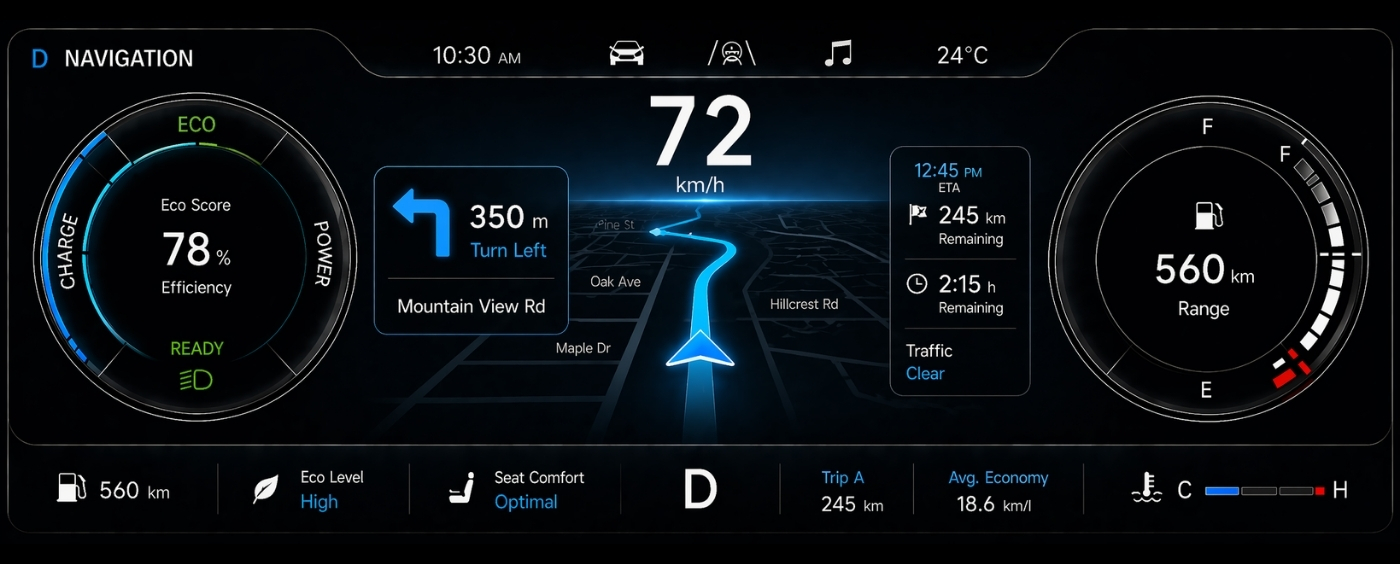
Modern vehicles are evolving into intelligent ecosystems where information, safety, and experience converge. This project focused on designing a next-generation automotive cluster display HMI that moves beyond static dashboards — creating a dynamic, modular, and scalable interface system that delivers real-time driving intelligence, context-aware UI adaptation, and seamless integration of vehicle, navigation, and infotainment.
Disciplines
HMI Design
Information Architecture
Interaction Design
Prototyping
Year
2025
The Challenge
Traditional automotive dashboards suffer from information overload, poor prioritisation of critical data, lack of contextual adaptability, and a fragmented user experience across driving modes. The core design challenge was to build a system that prioritises, adapts, and communicates information intuitively based on driving context.
"From data to driving experience — we design interfaces that feel natural, predictive, and human."
Information overload
Poor data prioritisation
No contextual adaptability
Fragmented UX across modes
Design Principles
Navigation-first design with a clear visual hierarchy. Speed anchored permanently at centre. Every other element earns its place.
Adapts in real-time to driving context and conditions. 14 display modes, 4 trigger types, automatic mode transitions based on vehicle state.
Information appears exactly when needed, reducing cognitive load. Critical alerts cannot be dismissed. Passive information never competes.
Process
Cross-category inspiration drawing from automotive and consumer tech. We studied cluster systems across Hyundai Creta, Tata Sierra, and Renault Duster to understand where the industry stood — and where it needed to go.
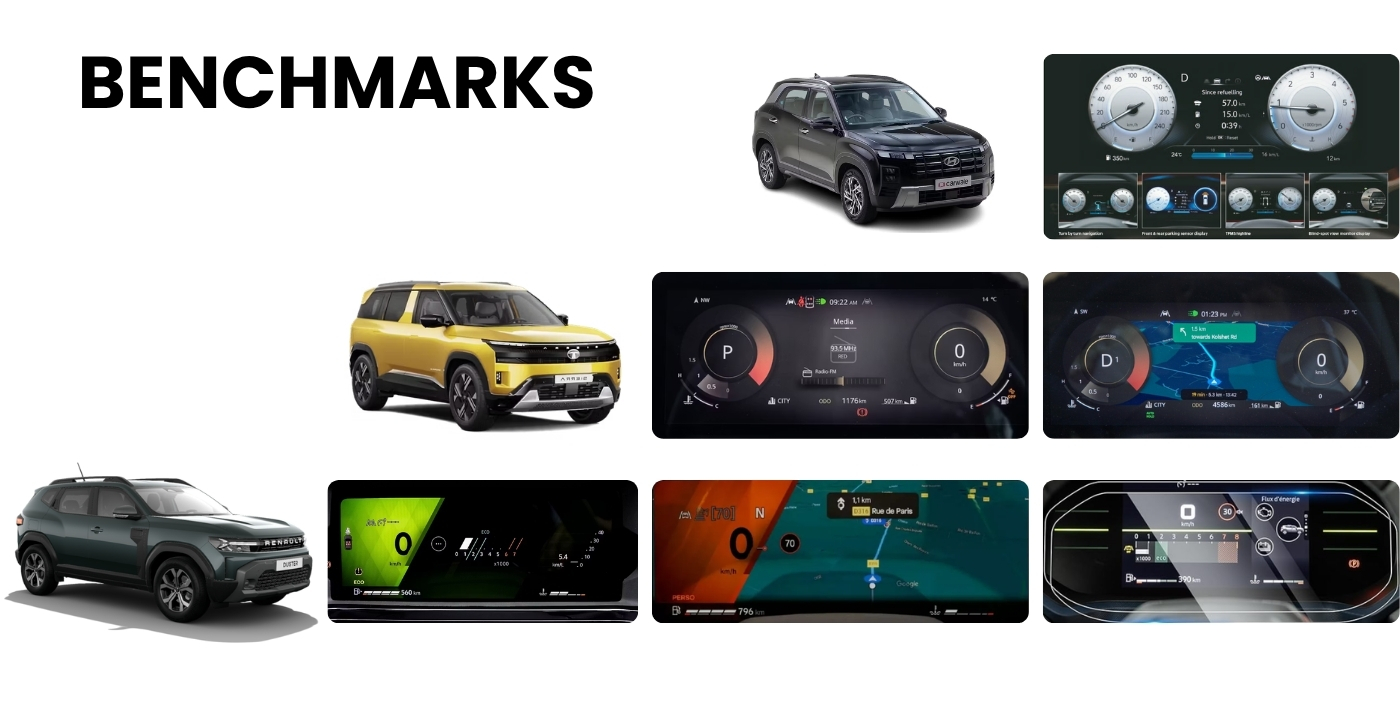
Hyundai Creta · Tata Sierra · Renault Duster — benchmark analysis
A five-zone cluster layout with 14 display modes, structured around a Time-to-React model — ensuring the most critical information is always closest to the driver's focus.
T1 — Immediate
Collision, over-speed, system fault. < 0.3s · Dead centre.
T2 — Tactical
Navigation, lane assist. 1–5s · Central canvas.
T3 — Strategic
Efficiency, trip totals. > 10s · Left & right dials.
T4 — Background
Clock, temperature, media. When convenient.
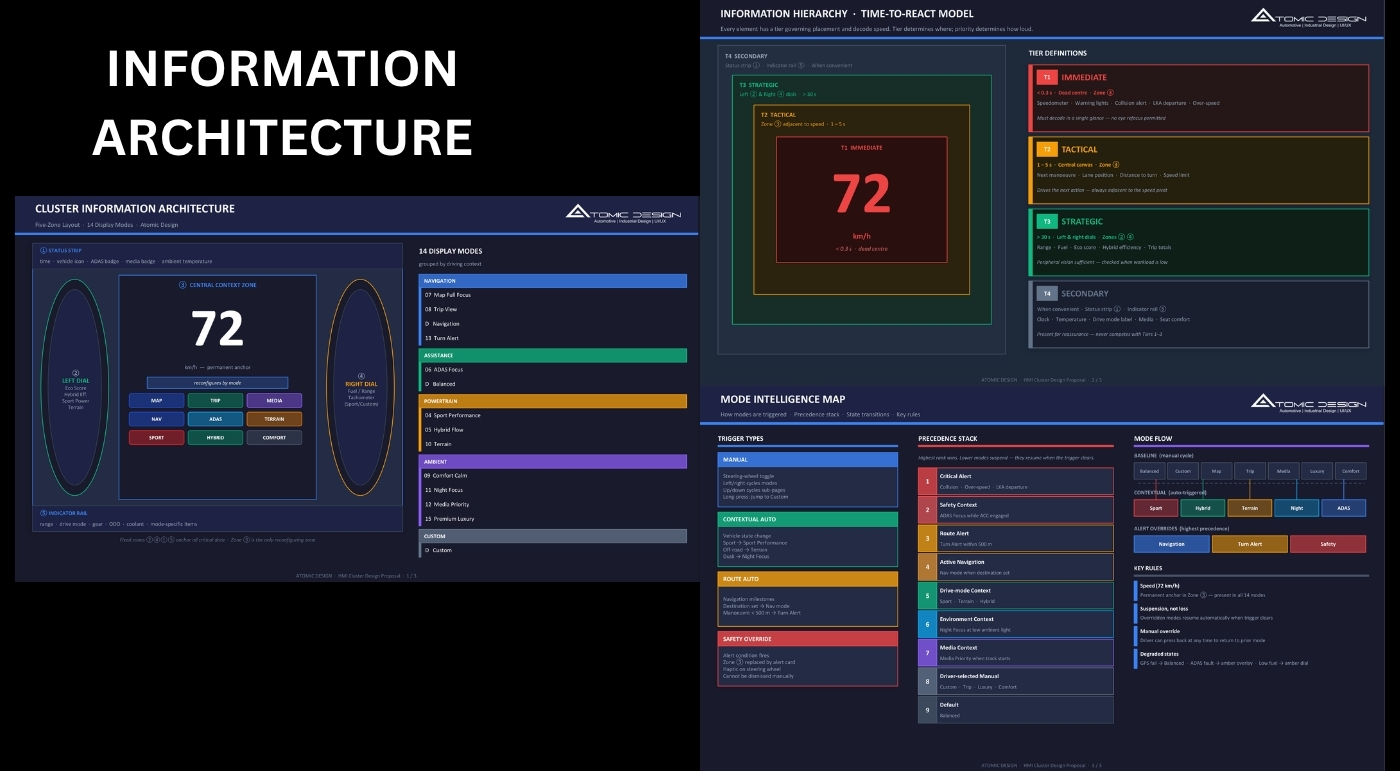
Cluster IA · Time-to-React Model · Mode Intelligence Map
Five-Zone Cluster Layout
Status
Time
ADAS
Media
Temp
Left Dial
ECO
78%
Efficiency
Central Zone — Always On
72
km/h — permanent anchor
Right Dial
560
km
Range
Rail
Range
Gear
ODO
Mode
Translating the IA into clear, glanceable layouts. Four directions were explored in parallel before converging on a centre-weighted hierarchy that balanced the familiar with the futuristic.
Central Focus (speed-first)
Dual Dial (familiar structure)
Navigation-led (route priority)
Modular Widgets (adaptive UI)
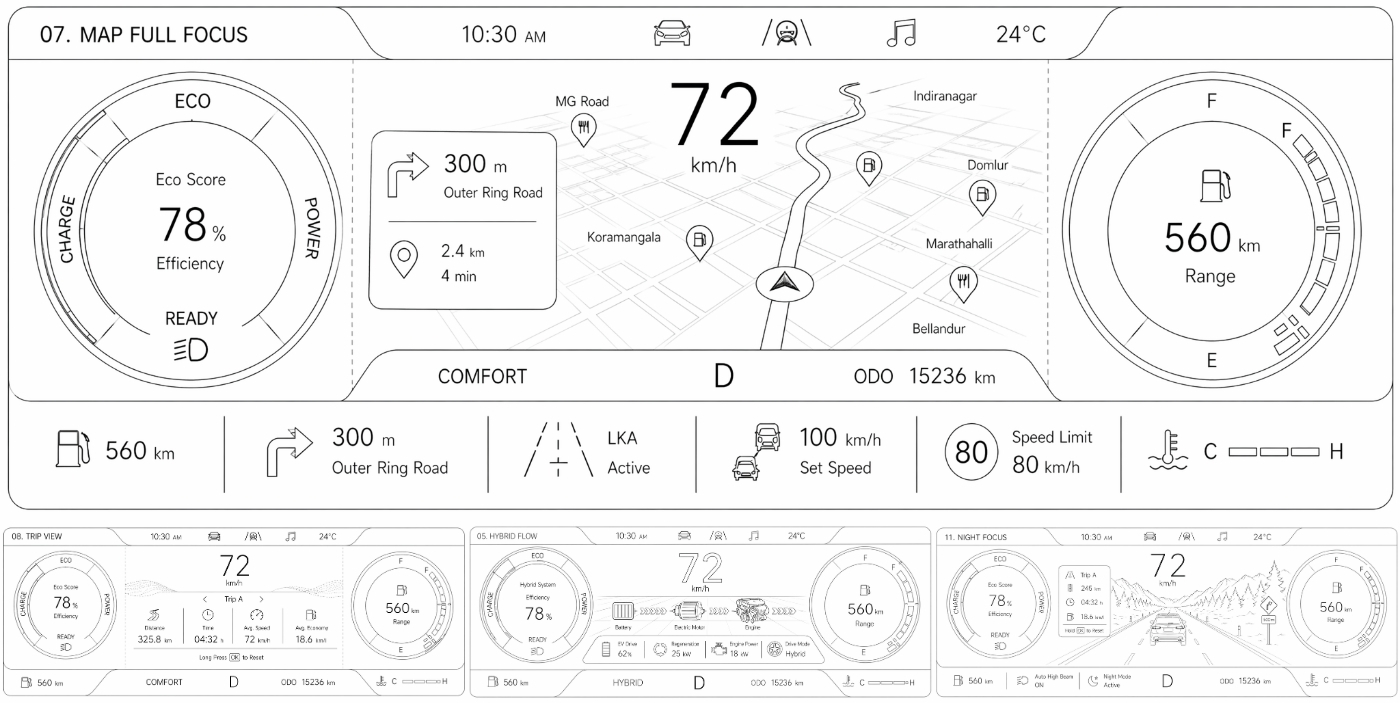
Wireframe exploration — Map Full Focus · Trip View · Hybrid Flow · Night Focus · Sport Performance
07. Map Full Focus
ECO
78%
READY
→ 300m
Outer Ring Road
2.4 km · 4 min
72
km/h
COMFORT
D
ODO 15236
RANGE
560km
FULL
⛽
560 km
→
300m Outer Ring
|↑|
LKA Active
🚗
100 km/h Set
80
Speed Limit
Balance of familiar + futuristic · Scalable across all 14 modes
Four trigger types govern how the cluster moves between modes. Safety overrides can never be dismissed by the driver until the condition clears.
Manual
Steering-wheel toggle · Cycles baseline modes · Driver is always in control · Single press returns to prior manual mode
Contextual Auto
Vehicle state changes trigger mode — Sport on → Sport Performance · Dusk → Night Focus · Climate on → Media Priority
Route Auto
Destination set → Navigation · Manoeuvre < 500m → Turn Alert · Driver can dismiss Turn Alert; Nav persists until arrival
Safety Override
Active alert → Zone ③ replaced by amber/red alert card · Haptic on wheel · Cannot be dismissed until condition clears
Clickable real-time simulations across all 14 modes. Validated for usability and engineering feasibility — including degraded states.
Speed glanceable at dead centre in 0.3s
Safety alerts non-dismissable
Manual override always available
Degraded states amber-flagged (GPS fail, ADAS fault, low fuel)
Mode Precedence Stack — Highest to Lowest Priority
Safety Override
Safety Context
Route Alert
Active Navigation
Drive-mode Context
Environment
Media Context
Driver Manual
Default Baseline
Final Design
14 fully resolved display modes. Each with a single driving intent, activation context, and a complete P1/P2/P3 information hierarchy.
Map Full Focus
Navigation-led layout. Full-width map in the central zone, speed anchored, eco score and range visible at a glance.
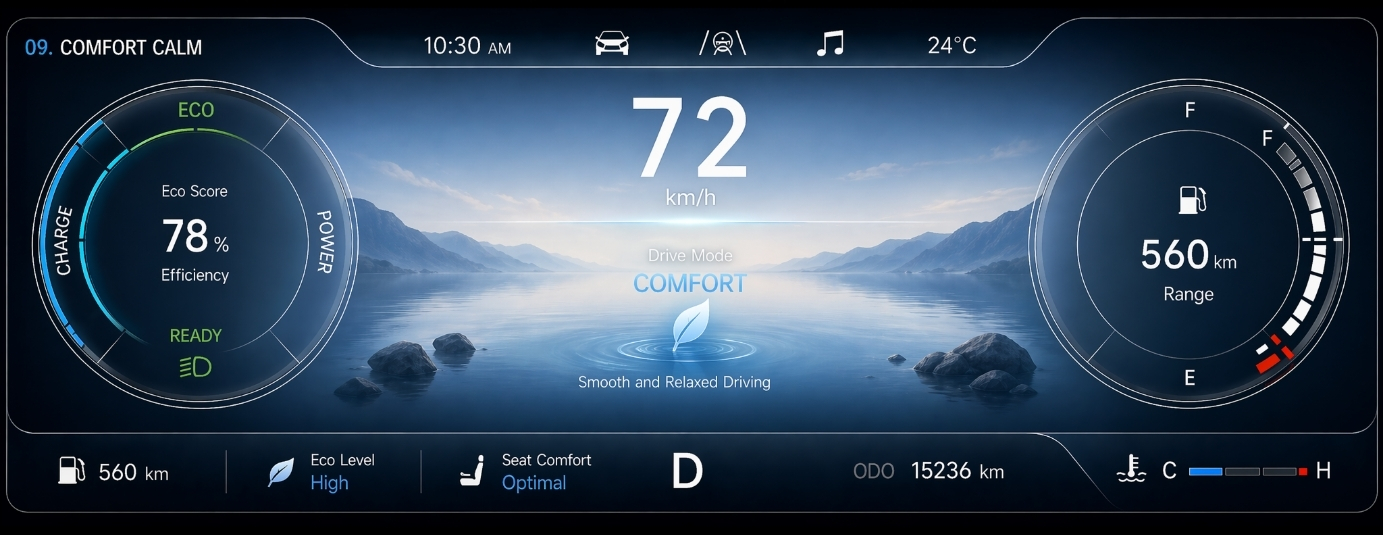
Comfort Calm
Ambient scenic backdrop, soft UI palette. Eco score, seat comfort, and drive mode surfaced — nothing to stress the driver.
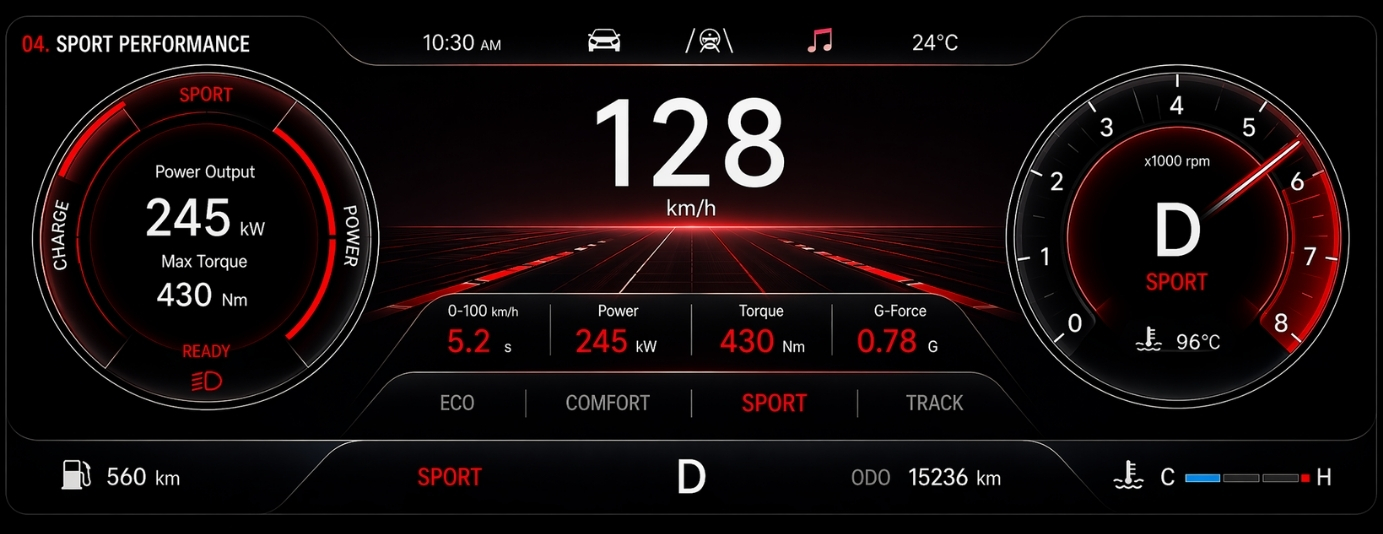
Sport Performance
Red-accented, tachometer-forward. G-force, power output, and track data elevated. The cluster transforms to match the drive.
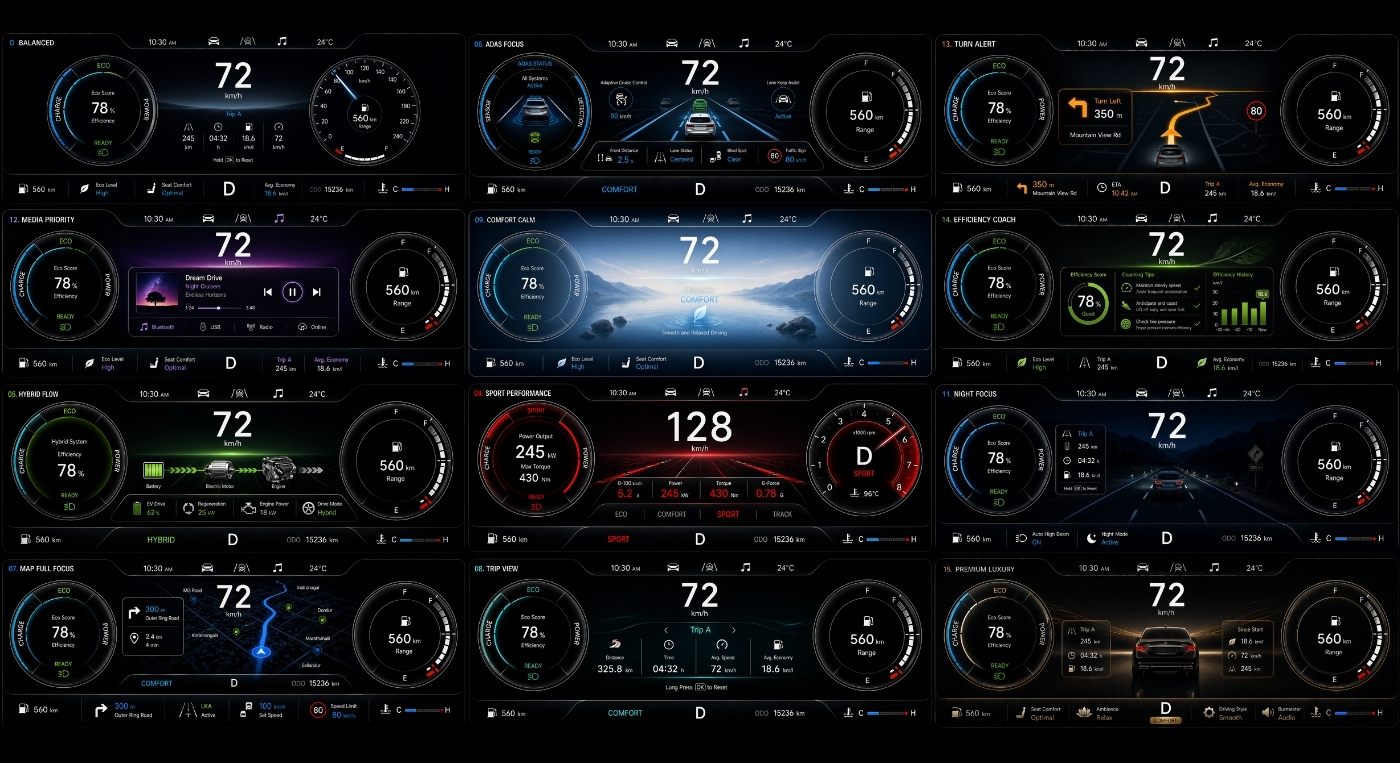
All 14 Display Modes
ATOMIC FLOW · 2025
Deliverables
Outcome
A validated, scalable HMI system with 14 distinct display modes and a clear mode intelligence framework. The 'Atomic Flow' UI language established a design vocabulary that is modular enough to adapt across different vehicle platforms while maintaining a consistent driver experience.
